
Blog
Your First Cobot Cell: A Practical Machine Tending Guide for Small and Mid-Size Job Shops
ArmMate
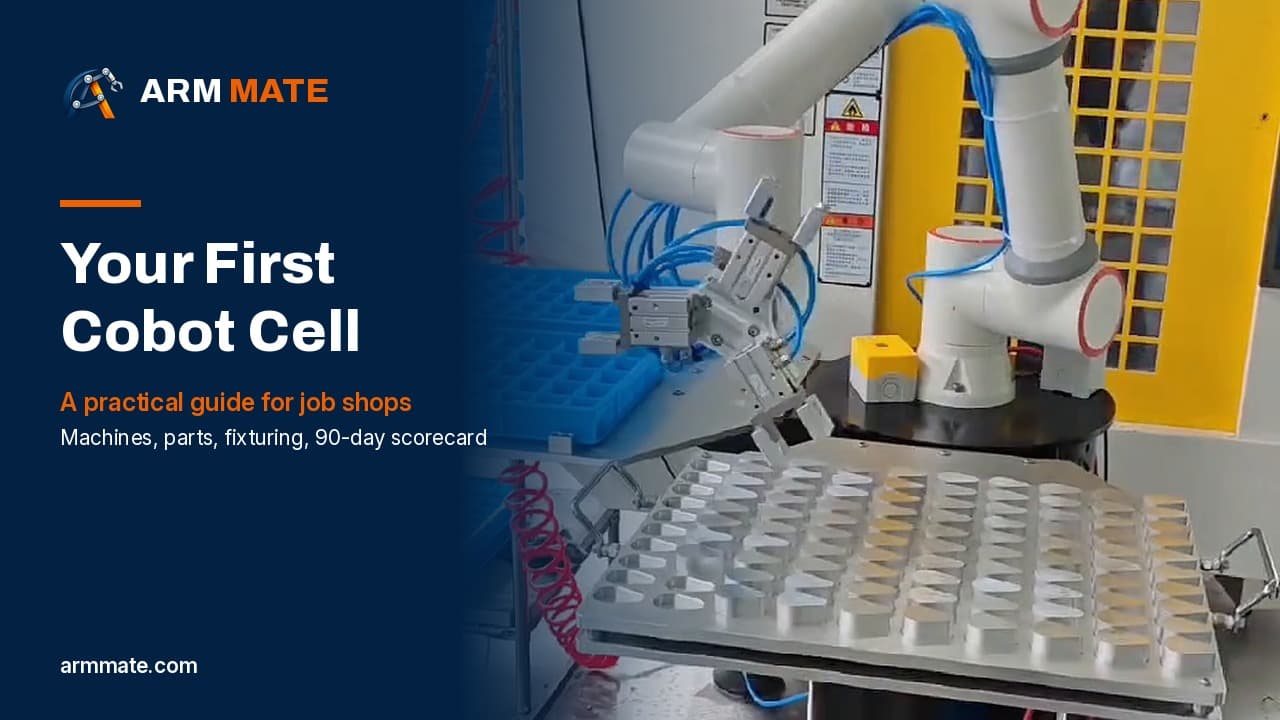
Most job shops do not need a lights-out factory. They need one machine that keeps cutting while their best machinist does something more valuable than opening a door and swapping a part. That first cell is where automation either earns trust on your floor or ends up pushed against a wall.
This guide is about getting that first cell right: which machine, which parts, how to hold and present them, how to handle changeover, and what to measure in the first 90 days.
Why small shops are looking now
The labor math has changed. The Manufacturing Institute and Deloitte project that U.S. manufacturing could need as many as 3.8 million new workers between 2024 and 2033, and that 1.9 million of those jobs could go unfilled if the skills and applicant gaps are not addressed. (The Manufacturing Institute: https://themanufacturinginstitute.org/manufacturers-need-as-many-as-3-8-million-new-employees-by-2033/)
Skilled time is expensive. The national mean wage for machinists was $28.52 an hour in May 2025, and $26.11 for CNC tool operators. (BLS OEWS, Machinists: https://www.bls.gov/oes/2025/may/oes514041.htm and CNC Tool Operators: https://www.bls.gov/oes/2025/may/oes519161.htm) In manufacturing, wages are only 66.9% of total employer compensation, so the loaded cost of that hour is higher. (BLS ECEC, June 2026: https://www.bls.gov/news.release/ecec.t04.htm)
And cobots are now a mainstream choice. North American companies ordered 7,212 collaborative robots in 2025, 19.6% of all robots ordered, according to the Association for Advancing Automation. (A3: https://www.automate.org/robotics/news/robot-orders-grow-6-6-in-2025-as-general-industries-drive-broader-automation-adoption)
Step 1: Pick the right machine
Your first cell should go on the machine that gives you the cleanest win, not the one with the biggest problem. Look for:
- A machine that waits on people. Walk the floor and note which spindle sits idle between cycles because the operator is busy elsewhere.
- Cycle times that leave room. Very short cycles keep the robot (and you) racing. Cycles of a few minutes or more give the cobot time to load, unload, and stage the next blank with margin.
- A door and workholding you can automate. An automatic door, or one that can be retrofitted with an actuator, plus workholding that can open and close on a signal from the robot.
- Space in front of the machine. Room for the cobot base, a part table or drawer, and a clear path for your operator to reach the control and do setups.
- A cooperative control. You will need a few I/O signals between the CNC and the robot (cycle start, cycle complete, door open, vise open). Most modern controls can do this. Confirm it before you buy anything.
Step 2: Pick the right parts
The best first-cell parts are boring, and that is a compliment.
Good candidates:
- Repeat jobs you run every month, ideally a family of parts with similar size and shape.
- Blanks that are consistent: same stock size, square cuts, no heavy burrs.
- Parts well within the cobot's rated payload, including the gripper.
- Simple grip surfaces: flats, outside diameters, or bar stock.
- Op-1 and op-2 parts where a second setup can be flipped and reloaded.
Save for later:
- One-off jobs and prototypes.
- Parts that need hand deburring or inspection between every cycle.
- Large, heavy, or awkward parts that push payload or reach limits.
- Parts with inconsistent castings or forgings that do not seat the same way twice.
Step 3: Fixturing that a robot can trust
A person can feel when a part is not seated. A robot cannot, so the fixture has to do that job.
- Automatic workholding. Pneumatic or hydraulic vises and chucks that open and close on command are the backbone of most tending cells.
- Positive locating. Hard stops, dowels, or a datum face so the part lands in the same place every time.
- Chip and coolant control. An air blast on the vise jaws and gripper before each load keeps chips from lifting the part. Chips on a datum are the most common cause of bad parts in a new cell.
- Part-present confirmation. A simple sensor or air-gauge check that the part is seated before cycle start is cheap insurance.
Step 4: Part presentation
How blanks come to the robot decides how long the cell can run without a person.
- Grid trays or templates with a pocket per part are the simplest and most flexible. Swap the template when the part changes.
- Drawers or stacked trays extend unattended run time for the same floor space.
- Orientation matters. Present every blank the same way, and design finished-part drop-off so parts do not bang into each other.
Count your run time: number of blanks on the table times cycle time. That is how long your cell can run between refills, and it is one of the most useful numbers you can track.
Step 5: Plan changeover from day one
High-mix shops worry that automation means one part forever. With a cobot cell it should not.
- Standardize gripper fingers by part family, with quick-change mounting.
- Keep one tray template and one robot program per part number, named and stored like your CNC programs.
- Write a one-page changeover checklist: program, fingers, template, vise jaws, first-article check.
- Time it. Your first changeover will be slow. The goal is to make it repeatable and then shorter.
Step 6: Safety is part of the cell, not an add-on
There are no robotics-specific OSHA standards, but general requirements such as machine guarding (29 CFR 1910.212) and lockout/tagout (29 CFR 1910.147) still apply to the cell. (OSHA Robotics, Standards: https://www.osha.gov/robotics/standards)
The current robot safety standards, ISO 10218-1:2025 and ISO 10218-2:2025, adopted in the U.S. as ANSI/A3 R15.06-2025, treat safety at the level of the whole application: the robot, gripper, part, machine, and task together. (A3: https://www.automate.org/robotics/news/new-ansi-a3-r15-06-2025-american-national-standard-for-industrial-robot-safety-now-available-for-purchase) A cobot next to a CNC still needs a risk assessment that covers sharp parts, pinch points at the vise and door, and how people move around the cell.
Step 7: What to measure in the first 90 days
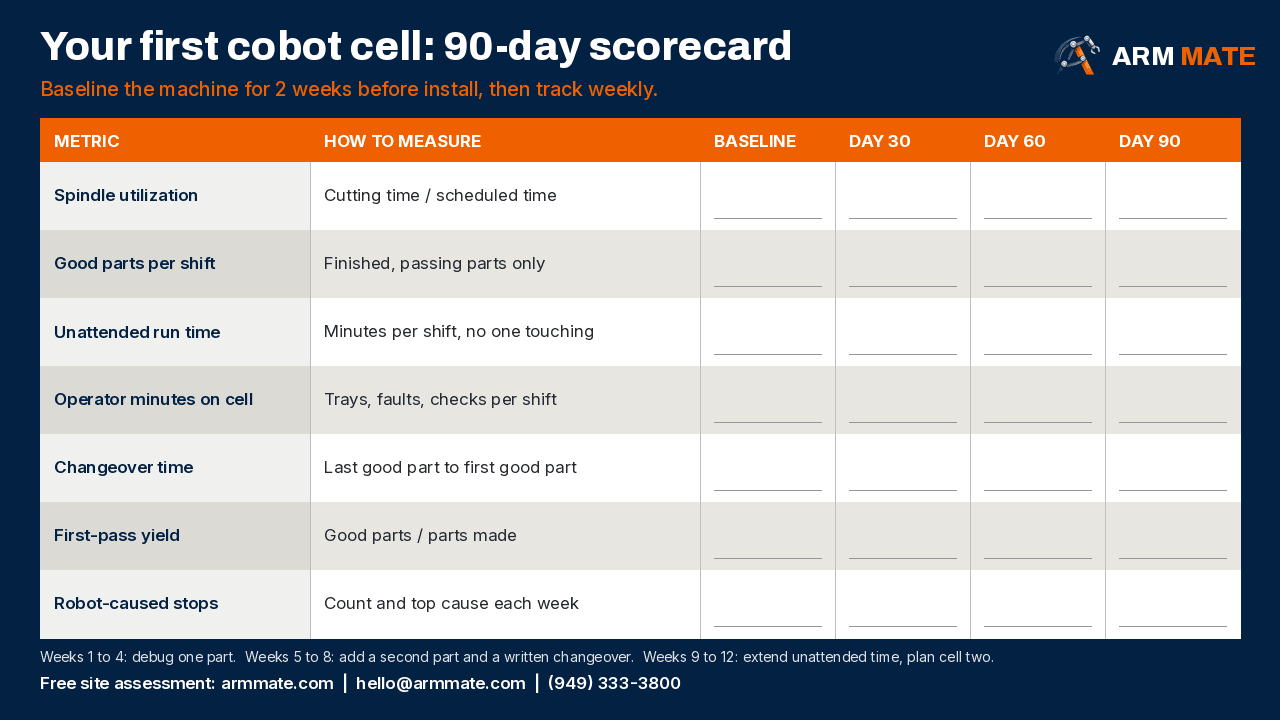
Take a baseline on the target machine for two weeks before install. Then track the same numbers weekly.
- Spindle utilization. Percentage of scheduled time the spindle is actually cutting. This is the headline number.
- Good parts per shift. Count finished, passing parts, not cycles.
- Unattended run time. Minutes per shift the cell ran with no one touching it.
- Operator minutes per shift on the cell. Loading trays, clearing faults, checks. This should fall as the cell matures.
- Changeover time. Minutes from last good part to first good part on the next job.
- First-pass yield and scrap. Watch for chip-related seating issues early.
- Robot-caused stops. How often the cell stops for a robot or gripper issue, and why. Fix the top cause each week.
A healthy first 90 days usually looks like this: weeks 1 to 4, debug and tune on one part. Weeks 5 to 8, add a second part number and a written changeover. Weeks 9 to 12, extend unattended run time and decide where cell number two goes.
The bottom line
The first cell is not about the robot. It is about choosing a machine with idle time, parts that behave, fixturing that locates, a tray that holds enough blanks, and a scorecard you actually check. Get those right, and the second cell is an easy decision.
ArmMate integrates collaborative robots for CNC machine tending on the machines you already run, with assessment, install, and support from our Irvine team.
Book a free site assessment. We will walk your floor, look at your machines and part mix, and tell you which machine should get the first cell, or if it is not a fit yet.
Book at armmate.com (https://armmate.com).
hello@armmate.com | (949) 333-3800 | armmate.com (https://armmate.com)
ArmMate, 15642 Sand Canyon, Irvine, CA 92618
Sources
- The Manufacturing Institute and Deloitte, "Manufacturers Need as Many as 3.8 Million New Employees by 2033," April 3, 2024. https://themanufacturinginstitute.org/manufacturers-need-as-many-as-3-8-million-new-employees-by-2033/
- U.S. Bureau of Labor Statistics, OEWS May 2025, Machinists (51-4041). https://www.bls.gov/oes/2025/may/oes514041.htm
- U.S. Bureau of Labor Statistics, OEWS May 2025, Computer Numerically Controlled Tool Operators (51-9161). https://www.bls.gov/oes/2025/may/oes519161.htm
- U.S. Bureau of Labor Statistics, Employer Costs for Employee Compensation, Table 4, June 2026. https://www.bls.gov/news.release/ecec.t04.htm
- Association for Advancing Automation (A3), "Robot Orders Grow 6.6% in 2025," Feb 6, 2026. https://www.automate.org/robotics/news/robot-orders-grow-6-6-in-2025-as-general-industries-drive-broader-automation-adoption
- OSHA, Robotics: Standards. https://www.osha.gov/robotics/standards
- Association for Advancing Automation (A3), "New ANSI/A3 R15.06-2025 American National Standard for Industrial Robot Safety Now Available for Purchase," Sep 9, 2025. https://www.automate.org/robotics/news/new-ansi-a3-r15-06-2025-american-national-standard-for-industrial-robot-safety-now-available-for-purchase