
Blog
Cobot Machine Tending for Small CNC Shops
ArmMate
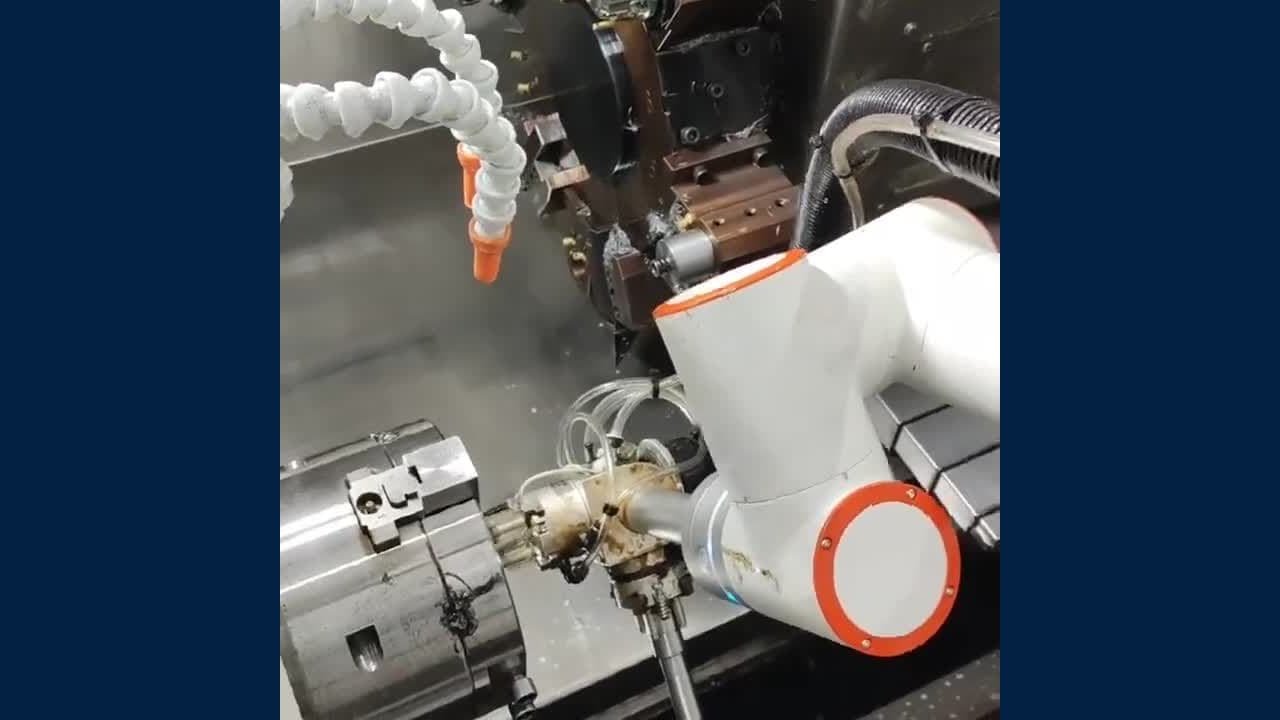
A small CNC shop usually does not have a spare operator for the second machine, or for the hours after the day shift leaves. The spindle is often fine. The door is the bottleneck. Someone opens it, pulls the finished part, puts the next blank in, closes it, and starts the cycle. Then they wait, or they walk to the other machine and the first one sits.
A cobot can take that reach. It does not replace the machinist who sets the job up, checks the first article, or hears a bad cut. It takes the repeated open, load, close, and unload on a job that is already stable. That is machine tending for a shop that still runs the machines it owns. ArmMate CNC machine tending starts there: the machine stays, and the cell is designed around it.
The job a small shop should pick first
Do not start with the hardest part in the building. Start with a job you already know how to run. A good first candidate has a few traits you can check on the floor this week.
- The cycle is long enough that a person is standing around, or short enough that they cannot leave the door.
- The part has a grip that does not change every piece. A consistent outside diameter, a flange, or another feature a gripper can find.
- Blanks and finished parts can sit in a tray, a rack, or a simple fixture the arm can reach without a person restacking them every cycle.
- The door, the chuck or the vise, and the chip conveyor leave a path the arm can use. If the door swings through the only place a pedestal can stand, write that down now.
- Changeover is not every hour. A cell can be retaught, but a job that never repeats is a poor first cell.
Mills, lathes, and repetitive secondary work are the usual places. On a mill the cycle is door open, load, close, start, unload. On a lathe it is chuck load and unload between cycles, with a fixture that matches the part family. Deburr, wash, or gauge can follow the spindle when that work is repetitive enough to program. Those are the same use cases on the CNC page.
If the part family changes every morning, or the blank arrives as a remnant with no repeatable grip, keep a person on that machine. A cobot is a bad fit for a job you cannot describe twice the same way.
What the cobot does, and what it leaves with a person
In a tending cycle the arm waits for the machine, works the door, takes the finished part out, puts the next part in, and gets clear before the spindle starts. An example cycle on this site shows unload, then load, on a lathe.
The attended cycle comes first
The person stays. Someone still proves the first piece, watches tool wear, and stops the cell when the job is wrong. Lights-out hours are a result of a cycle that already runs clean while people are in the building. We start by making the attended cycle reliable. A quiet night shift is not the first milestone.
The work that should stay human
The shop keeps the work the cobot should not touch: programming a new family, talking to the customer, fixture design, and the odd job that will not sit in a tray. Machine tending is the repeated reach at the door. It is not the whole trade. Shops that treat it that way keep their best people on the work that needs judgment.
What to write down before anyone quotes
A useful assessment is a list, not a brochure. Walk the machine with these notes in hand. You do not need a finished layout. You need the facts a layout depends on.
The machine
Make, model, and whether the door is manual or automatic. Note how far the door swings, and whether a person can still reach the control with the arm parked. Write down the chuck or vise height, and anything that sticks into the reach: a bar feeder, a tool setter, a coolant hose, a hoist.
The part
Weight of the heaviest blank, including anything the gripper has to carry with it. Where it can be held. How it is oriented in the chuck or the vise. How many variants share that grip. If you only know the drawing weight and not the real blank, weigh one. A guess here becomes the wrong arm later.
Where parts sit
Where raw parts sit today, and where finished parts go. A cobot needs a place it can find the next part without a person handing it over. Trays, a small rack, or a fixture plate are normal. A bin of tangled parts is a different project, and it may not belong in the first cell. The fuller list is in what a CNC cobot cell actually needs.
The people and the hours
Who stands at the door now, and which hours the machine is idle because nobody is there. Name the lead operator who would restart the cell. If that person does not exist yet, the cell is not ready, even if the arm would fit in the aisle.
Time, ownership, and the only published price
ArmMate's project path is assess, design, install and program, then support. The ranges on how a project runs are typical ranges, not a promise for your shop: about 1 to 2 weeks to assess, 2 to 4 weeks to design, and 1 to 3 weeks on site to install and train. Your window depends on the machine and on the downtime you can give the install.
You buy and own the robot. A CNC cell does not have a published package price. It is quoted after the free site assessment, because the gripper, the mount, and the handshake with the machine are part of the job.
The only published ArmMate system price is for frying cobot systems, from $19,000 plus installation. That figure is not a CNC quote. Do not use it as one. If a vendor offers a single CNC number before they have seen the door, ask what the number leaves out.
Many buyers ask about Section 179 expensing. Talk to your tax advisor. This is not tax advice.
How to read a yes, and how to read a no
A yes means the attended cycle can be made reliable on the machine you have. That includes a mount that clears the door, a gripper for that part family, a place for raw and finished parts, a safety zone people can work around, and a lead operator who can restart the cell. Acceptance is a site test against the cycle written in the proposal, before handover.
A no is also a result. Common reasons are a part that cannot be gripped the same way twice, a door path with nowhere to stand, or a mix of work that would spend more time in changeover than in the cut. We would rather say that on the floor than after a purchase order.
If you are comparing arm makers, the published Fairino, Duco, and Dobot figures are in the machine tending comparison, with the maker pages linked. Catalog numbers do not replace the walkthrough. Industry stories about other shops are not ArmMate results. The earlier note on why shops add a cobot points at those outside sources and labels them as such.
What to do this week
- Pick one machine that waits on a person between cycles.
- Weigh a blank, sketch the door swing, and note where parts sit.
- Name the operator who would own the cell after we leave.
- Ask for the assessment before anyone talks about a model number.
ArmMate is in Irvine. Email hello@armmate.com, call (949) 333-3800, or start at the assessment form. The shop address is 15642 Sand Canyon, Irvine, CA 92618.