
Blog
Machine Tending Cycle Time Math: How to Calculate Spindle Utilization
ArmMate
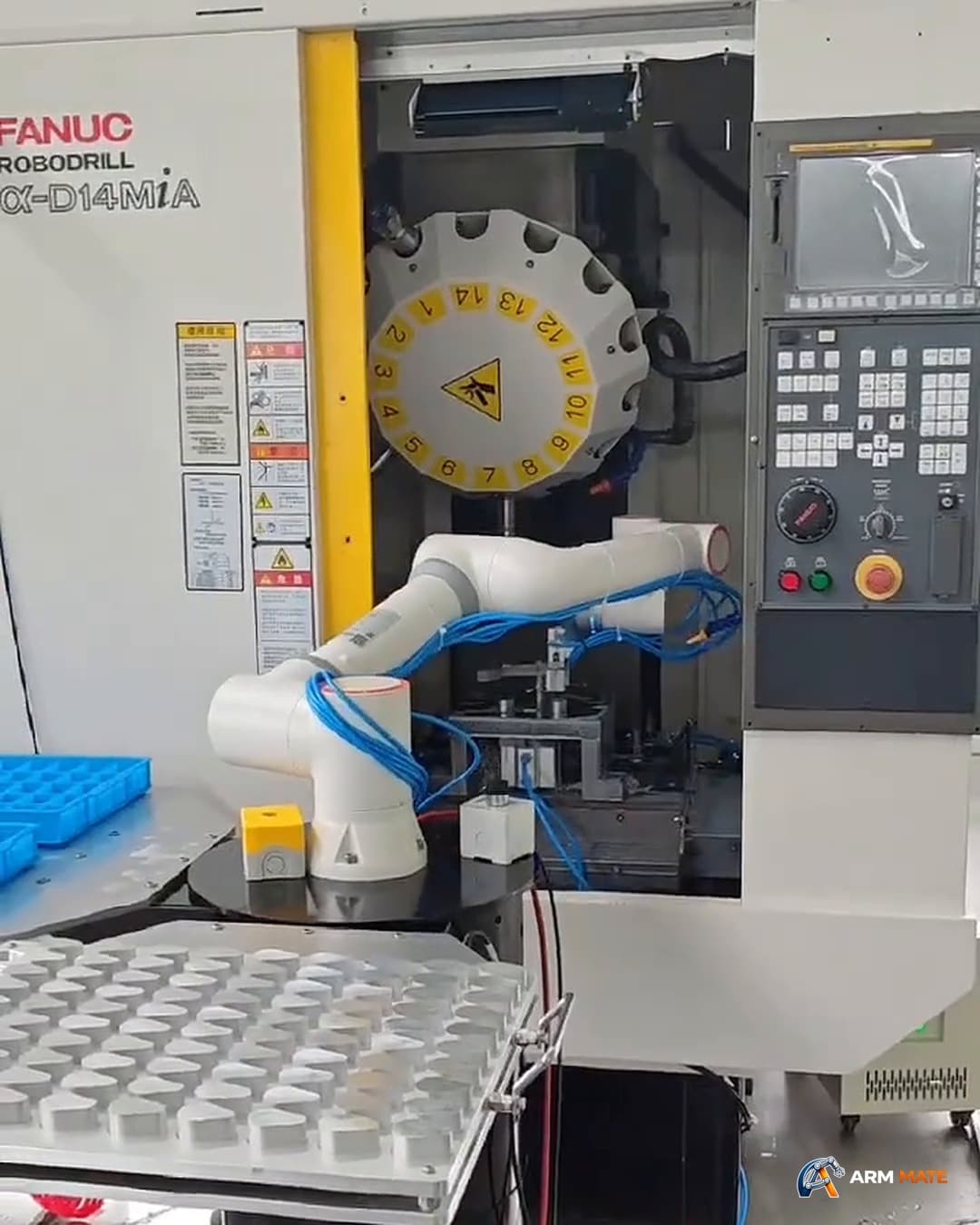
Before you look at any cobot, run the cycle time math on paper. It takes ten minutes, it needs no software, and it tells you whether a tended cell will make a visible difference on your floor.
Everything below uses your own numbers. We use minutes only, so you can plug in your shop.
Start with four variables
- C: cutting time per part, in minutes, from the program or a stopwatch.
- L: manual load and unload time per part, in minutes, including the door and cycle start.
- S: robot swap time per part, in minutes.
- A: minutes per shift when someone is actually at the machine.
Most shops know C. Fewer measure L honestly. Time it for a full shift, including the walks back to the machine after an interruption.
Spindle utilization, manual
If an operator tends the machine and is always available, one part takes C plus L. Utilization is:
U manual = C / (C + L)
If C is 6 minutes and L is 1 minute, U is 6 over 7, about 86 percent. That looks fine. The catch is the word always. In real shops the operator is also deburring, inspecting, moving material and answering questions. The effective L grows whenever the machine finishes and nobody is there.

Spindle utilization, with a robot
With a robot, the loop is the same but the waiting time shrinks and the swap time is predictable:
U robot = C / (C + S)
If S is 0.5 minute, U is 6 over 6.5, about 92 percent. The gain per part looks small. The bigger gain is that U robot holds all shift, instead of falling every time the operator is pulled away.
The real comparison is hours, not percent
Spindle hours per shift are what you sell. Estimate them for each case:
Manual cutting hours = (A / (C + L)) x C / 60 for the time someone is present, plus whatever the machine manages on its own.
Robot cutting hours = shift length x U robot, assuming parts are supplied.
Try it with a 7 hour effective shift. If the operator is at the machine for 4 of those hours, manual cutting hours might be around 3.4. With a robot holding 92 percent, the same shift gives about 6.4 hours of cutting. That gap is the opportunity. Your own numbers will differ, which is exactly why you run them.
Unattended run hours
The second question is how long the machine runs without anyone. That depends on how many blanks the cell holds.
Unattended minutes = N x (C + S)
where N is the number of blanks staged. If C is 6 minutes, S is 0.5 and the tray holds 40 blanks, the machine runs about 260 minutes, a bit over four hours, on one loading.
If you want to run through a lunch break, a change of shift or the evening, work backwards: required minutes divided by (C + S) gives the blanks you need to stage.
What shortens the benefit
Four things reduce the gain:
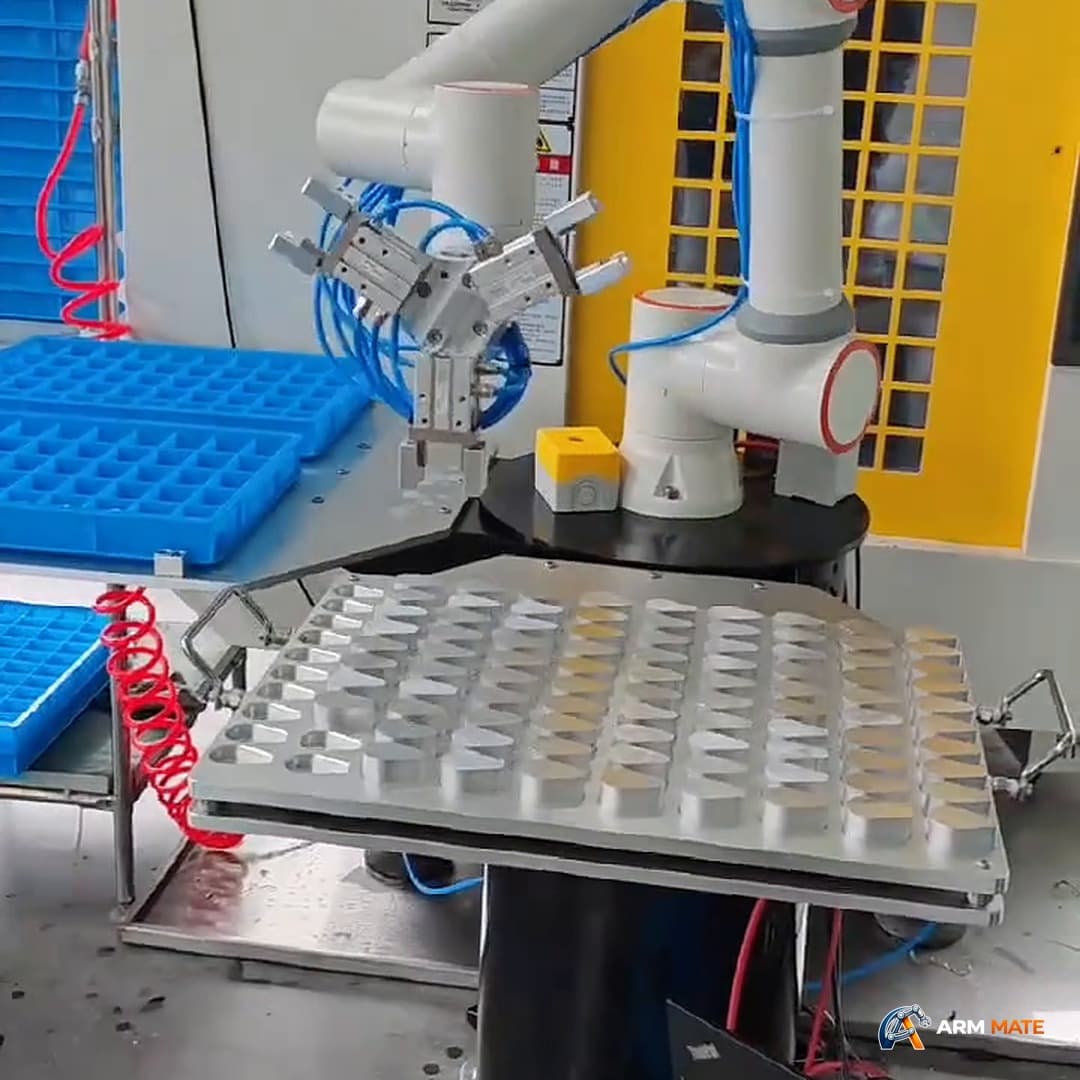
- Very short cycles. If C is under about a minute, S is a large share of each part. A robot may still be worth it for the labor, but the spindle gain will be modest. Our CNC example cycle walks through one unload and load sequence step by step.
- Slow swaps. A single jaw gripper that has to put the finished part down before picking a blank adds time. A two jaw gripper does both in one visit.
- Stoppages. Every alarm costs more than a minute. A cell that stops often has a low real U regardless of the formula.
- Finishing steps. Deburr, wash or inspect steps outside the loop have their own time that the formula does not see.
Add the interruption factor
Real data is better than a formula. For two days, log each time the machine sits finished and waiting. Note how long. Add them up. That total is wasted spindle time, and it is the number a robot attacks first.
Where setup time fits
None of this includes setup. Setup and changeover time are separate and affect how many jobs make sense for a cell. If a job runs for only an hour between changeovers, the loading time saved may be less than the changeover time added. Group repeat jobs into longer runs where you can.
A worksheet you can copy
- Write C for your top three parts.
- Time L over a full shift for each.
- Estimate S from a drawing of the robot path, or ask us to.
- Calculate U manual and U robot.
- Log idle waiting time for two days.
- Choose N for the unattended window you want.
From there, the value of the extra hours depends on your shop rate and your backlog. We keep the pricing conversation for after the site assessment, because the right cell depends on the machine and part.
FAQ
What is spindle utilization?
It is the share of available time the spindle is actually cutting. Higher utilization means more parts from the same machine and the same overhead.
How fast is a cobot swap?
It depends on the part, the reach and the gripper. A common planning range is under a minute for a simple swap, but you should confirm with a path simulation for your layout.
Does a cobot work if my cycle time is short?
It can, mainly through labor savings and consistent supply. The spindle gain is smaller because the swap is a larger share of each cycle. Longer cycles show the largest benefit.
Keep reading
- Cobot Machine Tending for Small CNC Shops covers what a first tended cell looks like in a small shop.
- CNC example cycle shows an example unload, then load.
Book a free site assessment
Bring your cycle times and we will work through the loop with you. Book a free site assessment at armmate.com/contact, email hello@armmate.com, or call (949) 333-3800. CNC cells are quoted after we see your machine and part.
Sources and further reading
The formulas above are planning arithmetic, not figures taken from these sources. Standards and web pages change, so check the current version before you rely on them.
- NIST, Performance of Collaborative Robot Systems. A NIST project page on methods and metrics for evaluating collaborative robot systems in flexible factories with short production runs.
- A3 (Association for Advancing Automation), What Are Collaborative Robots, Cobots. An overview of what collaborative robots are and where they are used, including repeatability and quick changeovers.
- U.S. Bureau of Labor Statistics, Occupational Outlook Handbook: Machinists and Tool and Die Makers. Describes how machinists set up, operate and monitor CNC machine tools, and notes that machinists set up, monitor and maintain systems such as CNC machine tools and autoloaders.