Blog
Which Weld Jobs Fit a Cobot? A Five Question Screen Before You Buy Anything
ArmMate
Most fab shops that call us about cobot welding ask the same first question: will it work on our parts? The honest answer is that it works on some of them, and the job is finding which ones before anybody spends money.
Cobot welding has grown up fast. The American Welding Society's Welding Digest traces it from light GMAW (MIG) work with no water cooling, to GMAW cobots arriving in 2017, then GTAW (TIG), weaving, stitch programming, Z axis voltage tracking and touch sensing, and now water cooled torches that handle high amp work (AWS Welding Digest, the evolution of cobot welding). The arm is rarely what limits a job now. The part is.
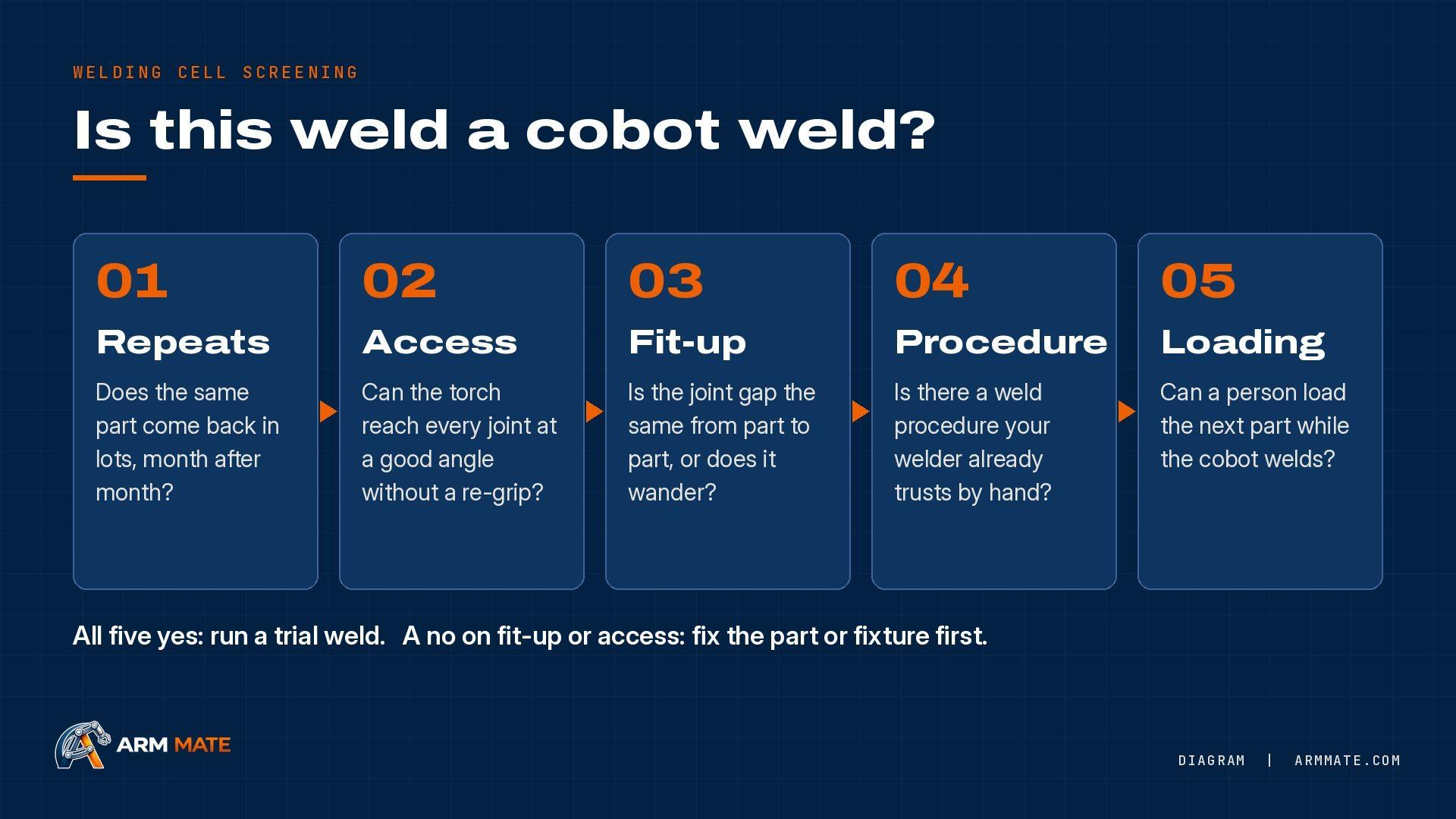
Here is the screen we use. Run your top ten weld jobs through it and you will know where to start.
1. Does the part come back?
A cobot earns its keep on parts that repeat: the same bracket, frame, tab or base every week or every month, in lots of a dozen or more. It does not need millions of parts. Cobots are built for short runs and quick changeover, and a saved program comes back the same as the day it was taught.
Look at a year of work orders. Parts that ran many times in modest lots are candidates. Parts that ran once are not.
2. Can the torch reach every joint?
Walk around the part with a torch in your hand. Every weld the cobot makes has to be reachable at a good torch angle and work angle without the part being flipped by hand mid program. If you need to reposition halfway, that is fine, but count it: it becomes either a second fixture, a positioner or an operator step.
Joints hidden inside a box section, or on the far side of a tall flange, often tell you the answer quickly.
3. Is the fit-up the same every time?
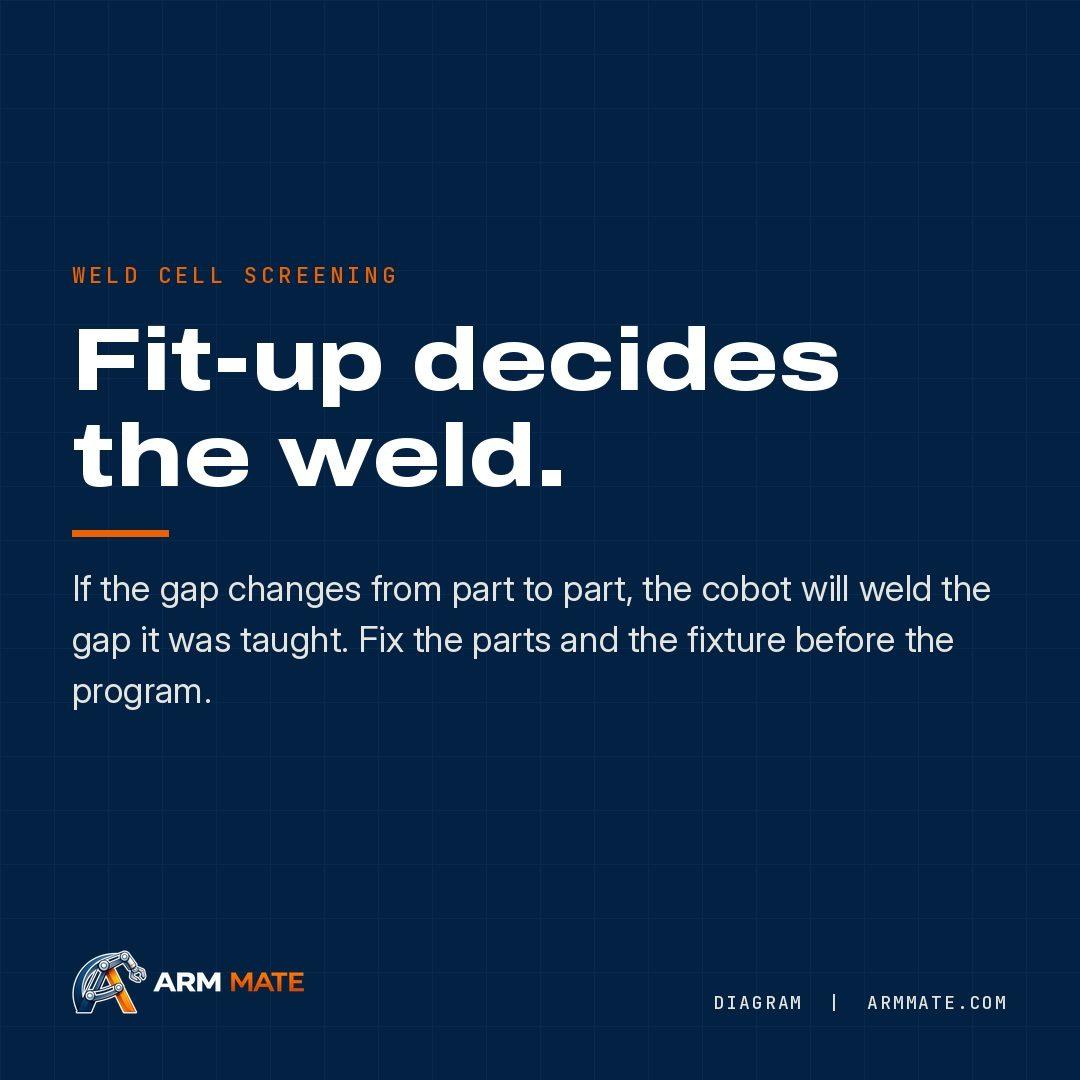
This is where most jobs pass or fail. A welder sees a wide gap and slows down, weaves, or adds a pass without thinking. A cobot welds the path and settings it was taught.
Touch sensing and seam tracking help a great deal with small part to part variation, and we cover them in our fixturing guide. They do not fix a laser cut part with a burr on one edge or a bent tab that lands in a different spot every time. If your fit-up wanders, fix the cut parts and the fixture first. The weld will follow.
4. Is there a procedure your welder trusts?
The best first job is one your welder already knows cold: wire, gas, amperage, voltage, travel speed and torch angle all proven by hand. AWS quotes a welding supervisor describing the cobot as letting you "establish a procedure that is followed precisely over and over again, akin to following a recipe" (AWS Welding Digest, weld setting optimization for collaborative robots).
That recipe has to exist first. A cobot is a terrible place to develop a weld procedure from scratch and a very good place to repeat one.
5. Can someone load while the cobot welds?
Count the minutes. If the cobot welds for four minutes and loading takes four minutes, a single fixture means the arc sits idle half the time. A second fixture station, or a split table, lets one side weld while the operator loads the other. If loading the part needs a crane and two people, the cell layout has to plan for that from day one.
Scoring the job
Give each question a yes, a maybe or a no.
- Five yes: run a trial weld on real parts.
- A no on fit-up or access: fix the parts or the fixture first, then screen it again.
- A no on repeats: keep it a manual job for now.
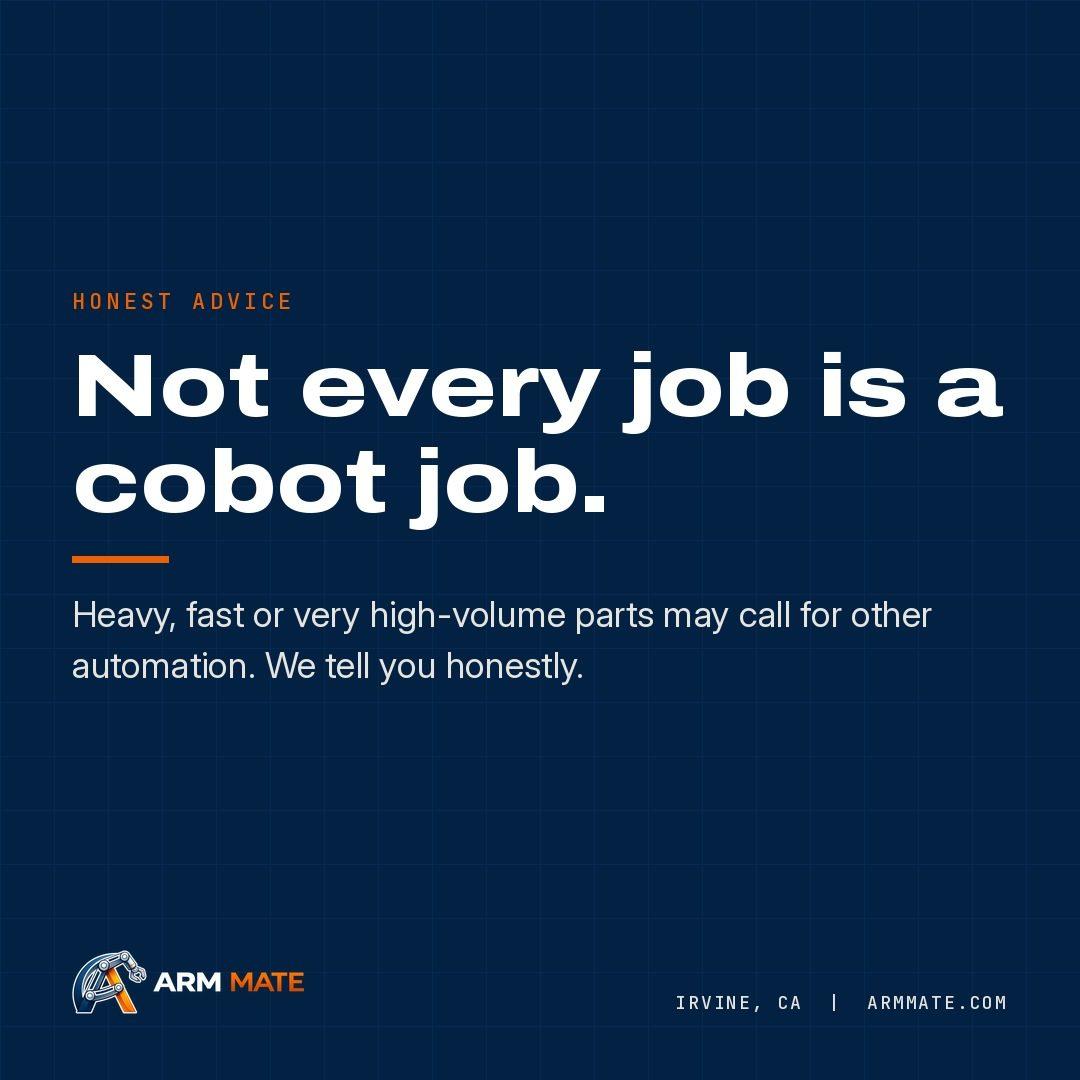
Not every weld is a cobot weld. Very high volumes with fixed tooling may suit a traditional robot cell better. One-off structural work may stay with your best welder. That is fine. The screen is there so you put the arm on the jobs where it wins.
What a trial looks like
Bring real parts, the fixture if you have one, and your welder. In a case study published by the International Federation of Robotics, the CEO of a high mix, low volume fab shop brought his own parts to an integrator's hands on session, and together they programmed 20 weld points in four hours. The shop went on to install four MIG cobot welders (IFR case study). That is the kind of evidence you want before a purchase decision: your parts, your welder, a real program.
How we scope it
Welding stations are part of our industrial cobot work out of Irvine. We screen the jobs with you, look at the fixture and fit-up, and tell you plainly which ones fit. You can see the steps on how it works.
FAQ
Do I need high volume for a welding cobot?
No. Repeat parts in modest lots are the sweet spot. The program is saved and recalled.
MIG or TIG?
Both are available on cobots today. Start with the process your welder already runs on that part.
What usually stops a job?
Inconsistent fit-up and joints the torch cannot reach.
Book a free site assessment
Pick your three most repetitive weld jobs and we will screen them with you on your floor. Book a free site assessment at armmate.com/contact, email hello@armmate.com, or call (949) 441-4828. ArmMate, 15642 Sand Canyon Ave #51176, Irvine, CA 92619. https://armmate.com