Blog
Retrofit or Replace? How to Automate Your Fry Station Without Ripping Out the Line
ArmMate
When restaurant operators start looking at fry automation, the first question is usually "What does it cost?" The better first question is "What do I have to tear out?"
A lot of kitchen automation is pitched as a whole new station: new fryers, new hoods, new footprint, new everything. Sometimes that's the right call. But for many kitchens, the fryers on the line today are paid for, sized for the menu, and working fine. The problem isn't the fryer. It's the repetitive, hot, high-turnover job of standing in front of it.
That's where a retrofit comes in. Here's how we think about retrofit versus replace when we walk a kitchen in Orange County or anywhere else.
Why the fry station first
The fryer is one of the most hazardous spots in any kitchen. OSHA calls deep fat fryers the number one cause of burns for young restaurant workers, from hot oil splashes, straining oil, and cleaning. (OSHA Young Worker Safety in Restaurants: Cooking)
Regulators take it seriously too. In one 2023 case, the U.S. Department of Labor fined a restaurant operator after a 15-year-old was burned lifting fries out of a fryer by hand, and noted the fryer had no automatic basket to lower and raise the food. (U.S. Department of Labor news release)
And the station has to be staffed every shift. Restaurants and foodservice employed about 15.7 million people in 2025, roughly 10% of the U.S. workforce, according to the National Restaurant Association. (National Restaurant Association: Hiring and Staffing research)
Hot, repetitive basket work that has to be covered every shift is exactly the kind of job a cobot is built for.
What "retrofit" actually means
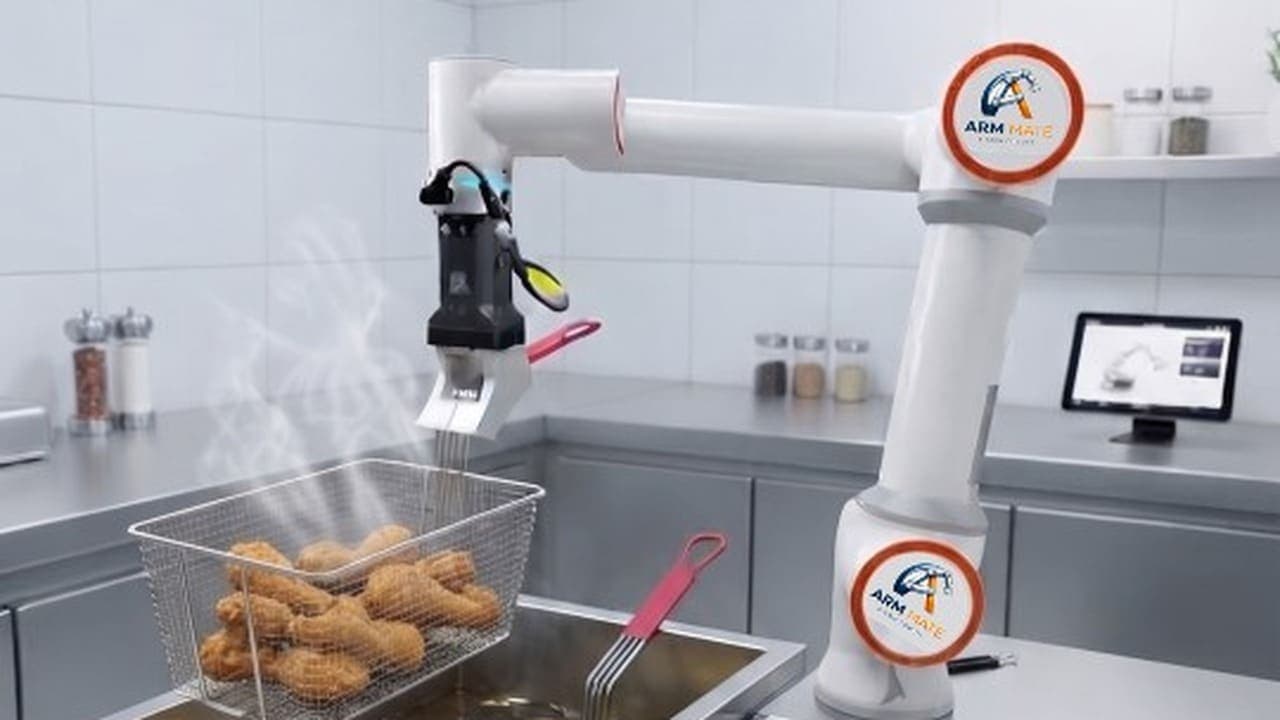
A fry station retrofit means adding a collaborative robot (a cobot) to the equipment you already run. The arm mounts next to your existing fryers, picks up the baskets your crew already uses, drops them, times them, shakes and drains them, and sets them down for plating.
Your fryers stay. Your oil management stays. Your hood and fire suppression stay. What changes is who is doing the basket work for hour after hour.
A replacement approach is different. It typically swaps the station for a purpose-built automated unit, which can mean new utilities, a new footprint, and re-approvals. That can make sense for a new build. It's a much bigger project for a kitchen that's already open and serving.
When retrofit is the better fit
In our experience, a retrofit tends to make sense when:
- Your fryers have useful life left. If the equipment is in good shape, replacing it to get automation means paying for capacity you already own.
- You can't afford downtime. A retrofit is installed around the existing line. A full station replacement can mean a longer shutdown of the station while it's swapped and re-commissioned.
- Your layout is tight. Cobots are built to work in a compact footprint alongside people, so the question becomes "Is there room for the arm and a safe working zone?" rather than "Can we redesign the line?"
- You want to own the asset. A retrofit cobot is a piece of equipment you own and can redeploy. If the menu changes or the line gets reconfigured, the arm can be re-programmed and moved.
- You run multiple locations with mixed equipment. Multi-unit operators rarely have identical fryers in every store. A retrofit approach adapts to what each site has instead of forcing a standard rebuild everywhere.
When replacing equipment is the honest answer
We'd rather tell you no than sell you the wrong project. Replacement is often the right move when:
- The fryers are near end of life anyway. If you're replacing them in the next year regardless, plan the automation into that purchase.
- You're building a new store. A new build is the cheapest time to design the station around automation from day one.
- The current layout can't support a safe working zone. If there's no way to give the arm room to work without crowding staff or blocking egress, a layout change may come first.
- The menu needs capacity the current fryers can't deliver. Automation makes a station more consistent. It doesn't add vats.
What a retrofit assessment looks at
Before anyone talks about a quote, we walk the station. A real site assessment should cover:
- Footprint and reach. Where the arm can mount, which vats and baskets it needs to reach, and where finished product lands.
- Baskets and handles. Whether your current baskets work as-is or need a simple handle adapter for a reliable grip.
- Workflow. How orders reach the station today, how drop times are tracked, and where a person still adds the most value (seasoning, plating, expo).
- Safety zone. How staff move around the station, where a person might reach in, and how the arm is set up to slow or stop around people.
- Power and mounting. Standard power availability and a solid mounting surface. Most cobot retrofits don't need new utilities, but you confirm that on site, not on a spec sheet.
- Cleaning and maintenance. How the station gets cleaned at close and how the arm fits into that routine.
A good assessment ends with a clear yes, a clear no, or "yes, after these changes." If an integrator can't tell you which one after walking your kitchen, keep asking questions.
The people side
Fry automation works best when it's framed as taking the worst part of the job off someone's plate, not taking the job. The basket work is hot, repetitive, and easy to get wrong when the station is slammed. Moving that to a cobot frees a cook to focus on quality, plating, and the parts of the line that actually need judgment.
Bring your crew into the process early. Let them see the arm run. The kitchens that get the most out of automation are the ones where the team helped decide where it goes.
The bottom line
If your fryers are working and your kitchen is already open, start by asking what you can keep. For many operators, the fastest and least disruptive path to an automated fry station is the equipment that's already on the line plus a cobot built to work next to people. ArmMate systems start from $19,000 plus installation, and we'll tell you on the walkthrough whether a retrofit actually makes sense for your station.
Want to know if your fry station is a retrofit candidate? Book a free site assessment. We'll walk your line, look at your fryers and layout, and give you a straight answer.
Book a walkthrough or see the fry station in action at armmate.com.
hello@armmate.com | (949) 333-3800 | https://armmate.com
ArmMate is a cobot integrator based in Irvine, California, retrofitting commercial kitchens and CNC shops with collaborative robots.
Sources
- OSHA, Young Worker Safety in Restaurants: Cooking. https://www.osha.gov/etools/young-workers-restaurant-safety/cooking
- U.S. Department of Labor, Wage and Hour Division news release, March 2023. https://www.dol.gov/newsroom/releases/whd/whd20230323-0
- National Restaurant Association, 2026 Research Insight: Hiring and Staffing. https://go.restaurant.org/rs/078-ZLA-461/images/2026-Research-Insight_Hiring-and-Staffing.pdf