
Blog
What a Cobot Site Assessment Actually Checks (and How to Prepare Your Kitchen or Shop)
ArmMate
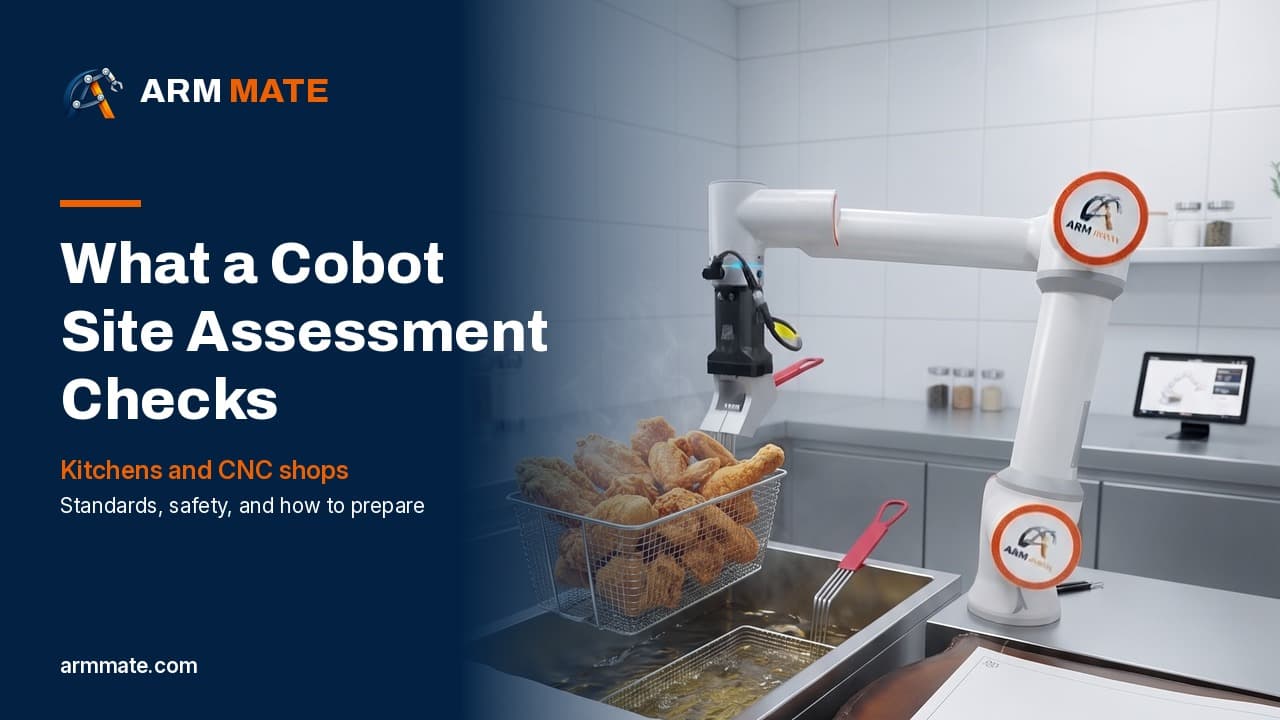
Before anyone should quote you a robot, someone should walk your space. A good cobot site assessment answers three questions: can a robot do this task here, can it do it safely around your people, and what has to change first? This article explains what a real assessment checks in a commercial kitchen or a machine shop, what the safety standards actually say, and how to prepare so the visit is fast and useful.
The standards in plain English
You will hear a few standard numbers during any robot project. Here is what they are.
- ISO 10218-1:2025 covers the robot itself: how robot makers design in safety functions, stopping, and speed and force limits. (ISO: https://www.iso.org/standard/73933.html)
- ISO 10218-2:2025 covers the robot application and cell: how an integrator puts the robot, tooling, parts, and surrounding equipment together safely. (ISO: https://www.iso.org/standard/73934.html)
- ISO/TS 15066:2016 is the technical specification on collaborative robot applications, best known for its body-region limits on contact force and pressure. Its collaborative requirements have now been incorporated into ISO 10218-2:2025, and the specification remains a reference. (A3 FAQ: https://www.automate.org/robotics/blogs/updated-iso-10218-faq and ISO: https://www.iso.org/standard/62996.html)
- ANSI/A3 R15.06-2025 is the U.S. national adoption of ISO 10218 Parts 1 and 2. (A3: https://www.automate.org/robotics/news/new-ansi-a3-r15-06-2025-american-national-standard-for-industrial-robot-safety-now-available-for-purchase)
Two points matter most for owners.
First, the 2025 standards no longer talk about a "collaborative robot" on its own. They use "collaborative application," because only the actual use of the robot, with its tool, part, and task, can be designed, tested, and confirmed as collaborative. (A3 FAQ: https://www.automate.org/robotics/blogs/updated-iso-10218-faq) A cobot holding a basket of hot oil, or a sharp machined part, is a different application from a cobot moving an empty tray.
Second, OSHA has no robotics-specific standard, but general rules such as machine guarding (29 CFR 1910.212) and lockout/tagout (29 CFR 1910.147) still apply, and OSHA points to R15.06 and its task-based risk assessment guidance as consensus standards. (OSHA Robotics, Standards: https://www.osha.gov/robotics/standards)
What a real assessment checks
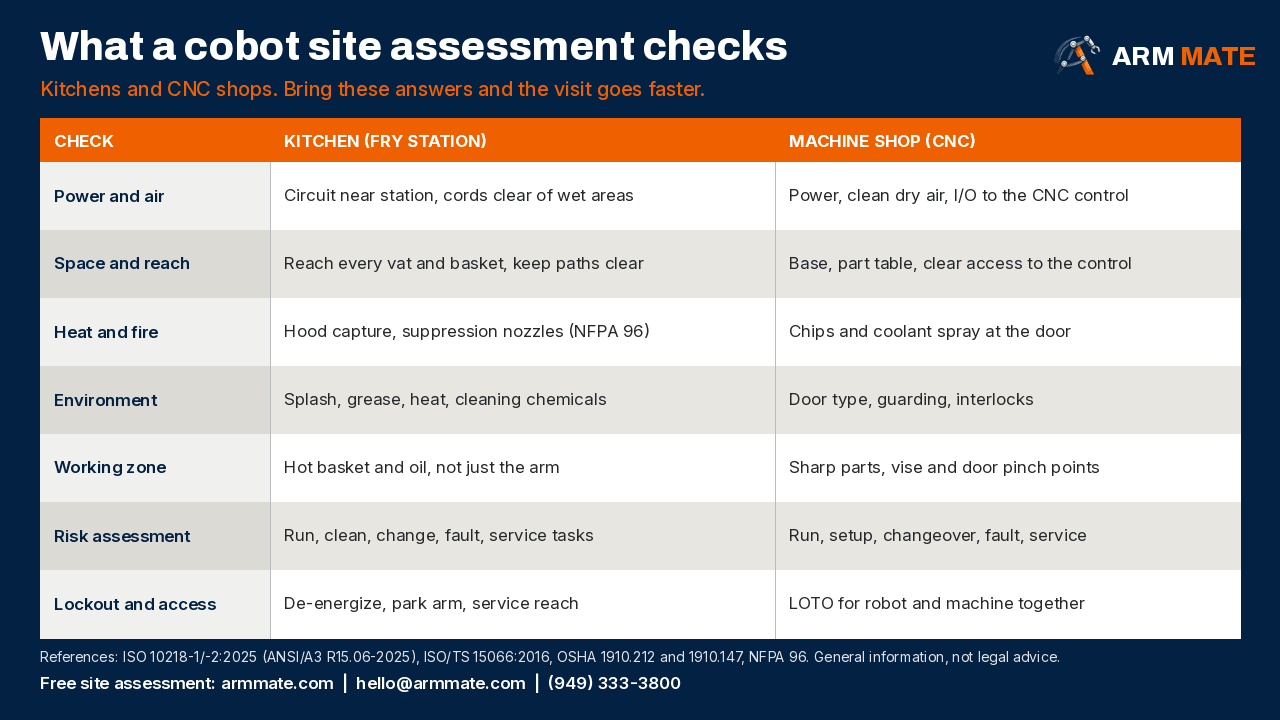
1. Power, air, and connectivity
Where the robot controller will plug in, whether there is a suitable circuit nearby, and whether cords would cross a walkway or wet area. In a machine shop, add clean, dry compressed air for pneumatic grippers and vises, and the I/O connection to the CNC control. In both settings, note whether you want the cell on your network for monitoring.
2. Floor space, mounting, and reach
The assessor measures the footprint for the robot base or pedestal, checks that the mounting surface is rigid and can be anchored, and runs a reach study: can the arm reach every basket, vat, vise, or tray it needs, with margin? Just as important is what the robot must not block: walkways, exits, the fryer's controls, the CNC control panel, and the path people use during a rush.
3. Heat, ventilation, and fire protection (kitchens)
Fryers bring three things a robot plan has to respect.
- Ventilation and fire suppression. Commercial cooking ventilation and fire protection are governed by NFPA 96, along with your local fire authority. (NFPA 96: https://www.nfpa.org/product/nfpa-96-standard/p0096code) The arm and its mount should not interfere with hood capture, suppression nozzles, or manual pull stations, and any change near the hood line should be reviewed with your hood and suppression service company.
- Heat and grease. The assessor compares conditions at the station against the robot's rated operating environment, and plans for splash, grease, and the cleaning chemicals your crew uses at close.
- People and heat. In California, Cal/OSHA's indoor heat standard applies to most indoor work areas when the temperature reaches 82 degrees F, with stronger requirements at 87 degrees F or in high radiant heat areas. (Cal/OSHA Indoor Heat FAQ: https://www.dir.ca.gov/dosh/heat-illness/indoor-faq.html) A fry station cobot can reduce how long a person stands over hot oil, but it does not replace your heat illness prevention plan.
4. Chips, coolant, and guarding (machine shops)
For CNC tending, the assessor looks at door type and automation, chip and coolant spray when the door opens, how the machine's own guarding and interlocks will work with the robot, and where a person stands to do setups and inspection.
5. Safeguarding and the working zone
This is where the collaborative application gets designed. Will the robot share space with people and rely on speed and force limits, or slow down and stop when someone approaches, or work behind a fence or light curtain for parts of the cycle? The answer depends on the task. Speed and force limits on the arm do not make a hot basket or a sharp edge safe on their own, so the assessment looks at the whole motion: the arm, the gripper, the payload, and what is nearby.
6. A task-based risk assessment
A useful risk assessment is a list, not a feeling. It covers:
- Every task, not just production. Normal operation, startup, changeover, cleaning, fault recovery, and maintenance.
- The hazards in each task. Pinch points, impact, hot surfaces and oil, sharp parts, electrical, slips.
- Who is exposed. Operators, other cooks or machinists, cleaners, managers, service techs.
- The controls. Design first (layout, speed and force limits, guarding), then procedures and training, then PPE.
- Verification. Test that the safety functions work as designed, then document it.
7. Lockout, cleaning, and service access
How the robot and the fryer or machine are de-energized for cleaning and maintenance, how the arm is parked out of the way at close, and how a technician reaches the controller.
How to prepare for your assessment
Gather these before the visit and the walkthrough goes much faster.
For a kitchen:
- Photos and a short video of the fry station during a busy period.
- Fryer make and model, number of vats, and the baskets you use.
- Your menu items that go through the fryer and your drop times.
- Rough station dimensions and where the hood, suppression nozzles, and pull station are.
- Hours the fry station is staffed, by shift.
- Your burn and injury history at the fryer for the last few years.
For a machine shop:
- Machine make, model, and control, and whether the door and workholding are automatic.
- Drawings or samples of two or three candidate parts, with cycle times and monthly volume.
- Stock sizes and how blanks are staged today.
- Photos of the space in front of the machine and the nearest power and air drops.
- Who runs the machine today and on which shifts.
For both: decide who on your team owns the project, and bring the people who work the station into the walkthrough. They know where the real pinch points are.
What you should walk away with
A good assessment ends with a clear answer: yes, no, or yes after these changes. You should get a written summary of the task, the layout, the open safety questions, the changes needed on your side, and a quote that matches what was actually checked. If an integrator cannot tell you which of the three answers applies after walking your site, keep asking questions.
Book a free site assessment with ArmMate. We assess kitchens and CNC shops across Southern California from our Irvine base, and we will give you a straight answer.
Book at armmate.com (https://armmate.com).
hello@armmate.com | (949) 333-3800 | armmate.com (https://armmate.com)
ArmMate, 15642 Sand Canyon, Irvine, CA 92618
This article is general information, not legal or engineering advice. Requirements vary by site and jurisdiction. Standards summaries reflect public sources as of October 20, 2026.
Sources
- ISO, ISO 10218-1:2025, Robotics, Safety requirements, Part 1: Industrial robots. https://www.iso.org/standard/73933.html
- ISO, ISO 10218-2:2025, Robotics, Safety requirements, Part 2: Industrial robot applications and robot cells. https://www.iso.org/standard/73934.html
- ISO, ISO/TS 15066:2016, Robots and robotic devices, Collaborative robots. https://www.iso.org/standard/62996.html
- Association for Advancing Automation (A3), "Updated ISO 10218: Answers to Frequently Asked Questions." https://www.automate.org/robotics/blogs/updated-iso-10218-faq
- Association for Advancing Automation (A3), "New ANSI/A3 R15.06-2025 American National Standard for Industrial Robot Safety Now Available," Sep 9, 2025. https://www.automate.org/robotics/news/new-ansi-a3-r15-06-2025-american-national-standard-for-industrial-robot-safety-now-available-for-purchase
- OSHA, Robotics: Standards. https://www.osha.gov/robotics/standards
- NFPA, NFPA 96, Standard for Ventilation Control and Fire Protection of Commercial Cooking Operations. https://www.nfpa.org/product/nfpa-96-standard/p0096code
- California Department of Industrial Relations, Cal/OSHA, Indoor Heat Illness Prevention FAQ. https://www.dir.ca.gov/dosh/heat-illness/indoor-faq.html